Asia Markets Wrap: China GDP Slows, Iran-US Tensions Rattle Oil
China's Q2 GDP hit a 3.5-year low while US-Iran military strikes sent oil surging and Korean markets into circuit breakers.
Asian markets faced a turbulent Tuesday session as China reported its weakest economic growth in three-and-a-half years, US and Iranian forces exchanged military strikes near the Strait of Hormuz, and South Korean equities surged so sharply that trading had to be halted twice. The confluence of geopolitical escalation and disappointing Chinese data dominated the regional FX and equity landscape on July 15.
China's Q2 GDP expanded just 4.3% year-on-year, missing the 4.5% consensus estimate and marking the slowest pace since late 2022. Sequential growth came in at 0.9% quarter-on-quarter, in line with forecasts. The data painted a mixed picture: June industrial output rose 5.3% year-on-year, beating the 4.6% estimate, and retail sales climbed 1.0% — defying expectations of a 0.1% contraction. New home prices, however, fell for a fourth consecutive year in June, declining 3.3% annually, though that was a slight improvement from the prior reading of -3.5%. Beijing has separately set an ambitious target of 60 trillion yuan in retail sales by 2030 under a newly unveiled consumption plan.
Read more Dan Ives Launches Yorkville Ives Merchant Bank After Wedbush Exit →
Geopolitical risk commanded equal attention after US forces struck dozens of Iranian military installations near the Strait of Hormuz, with Iran subsequently hitting US bases in Bahrain, Kuwait, and Jordan. Oil prices climbed to a one-month high on the escalation. Goldman Sachs noted that Gulf states are accelerating pipeline routes to bypass Hormuz, a move analysts say could shield the bulk of regional crude exports from prolonged disruption. President Trump confirmed that Washington had held talks with Tehran and urged Iran to reach a deal, injecting a note of cautious diplomacy into an otherwise hawkish exchange.
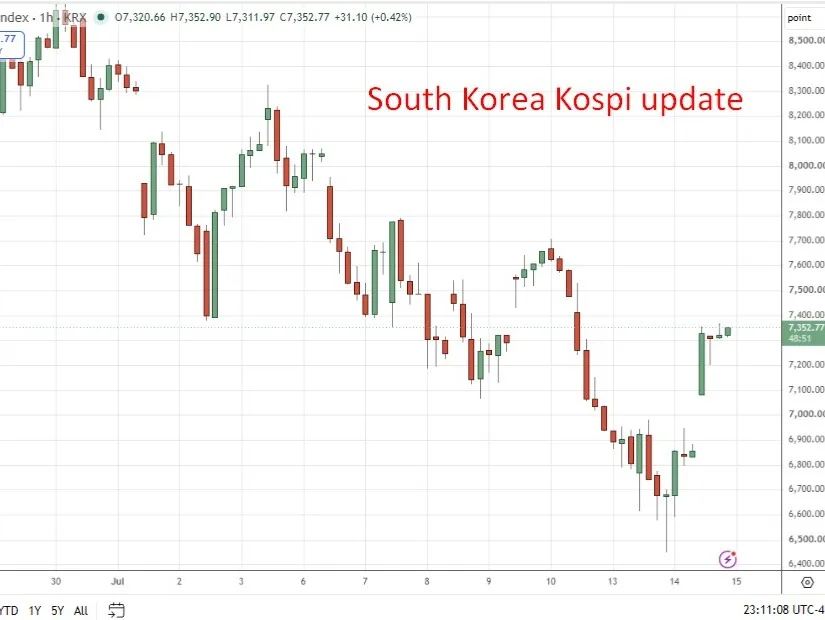
South Korean equities were the session's most dramatic story. The Korea Exchange halted trading twice as Kospi and Kosdaq futures surged, with chipmaker SK Hynix jumping roughly 12%. The Nikkei also rose, though gains were capped ahead of closely watched ASML earnings. The Bank of Japan remains on watch: a Reuters Tankan survey showed a divided business mood, and analysts noted that the key test for the next BoJ rate hike will be whether recent price increases prove durable. The PBOC fixed the USD/CNY mid-point at 6.7910, fractionally stronger than the market estimate of 6.7965.
Continue reading at Forexlive.