NZ Business Survey and China Trade Data Due Tuesday in Asia
Two policy-relevant releases hit Tuesday: New Zealand's Q2 business survey and China's June trade figures, both testing recent recovery claims.
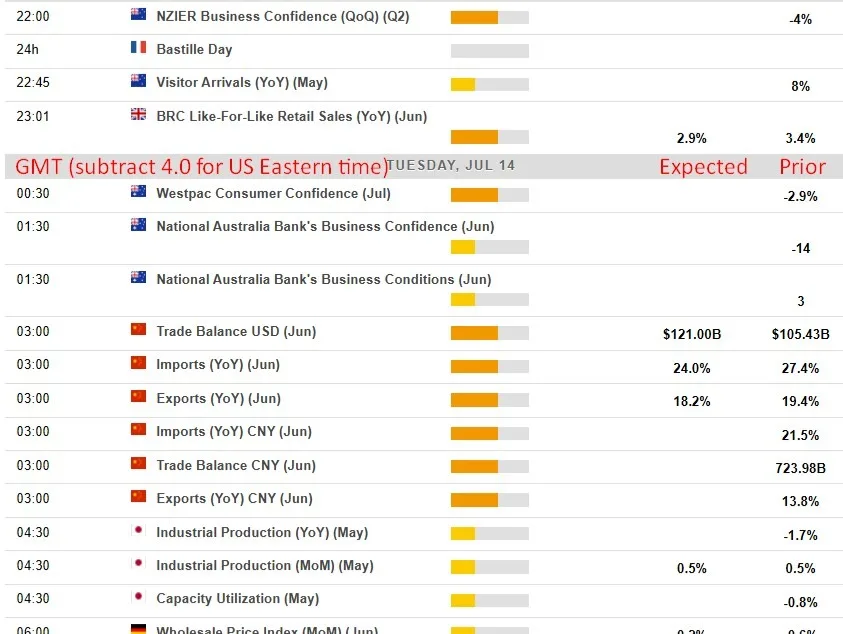
Two closely watched data releases will test the durability of Asia-Pacific recovery narratives on Tuesday, July 14, when New Zealand publishes its Q2 business opinion survey at 2200 GMT and China follows with June trade figures around 0300 GMT. Neither release carries direct US market-moving weight in isolation, but both carry genuine implications for central bank policy and regional growth forecasts heading into the back half of 2026.
The NZIER Quarterly Survey of Business Opinion is drawing analyst attention not for its headline average but for the internal split within the survey window. Because the Q2 survey period straddled the mid-June Iran ceasefire, early responses and late responses likely captured very different operating environments. Westpac and ASB both flag this timing distortion as more informative than any blended number, with Westpac focused on whether pricing intentions stayed elevated even as oil retreated from conflict-driven highs — a signal that inflation pressures may be stickier than the commodity move suggests. ASB is monitoring capacity measures after Q1 data showed labor constraints ticking up and a second consecutive quarter of firms lifting selling price expectations.
Read more China June Trade Data Crushes Forecasts Amid AI Demand Surge →
China's trade print carries its own set of stakes as a lead indicator ahead of Wednesday's GDP release. Exports are forecast to cool modestly to 18.2 percent year-on-year from May's 19.4 percent, while imports are expected to decelerate to 24 percent from 27.4 percent. South Korean export data, a reliable early proxy, suggests semiconductor demand is driving the import side rather than any broadening of domestic consumption — a distinction that matters for how policymakers read the recovery's foundations.
Forecasts for China's trade figures span a wide range, with some international banks projecting growth near 20 percent and more cautious domestic Chinese research houses penciling in figures as low as 12 percent. The trade surplus is expected to widen to roughly $120.6 billion. A soft imports reading alongside resilient exports would reinforce the view that external demand, not household spending, is still carrying the load — complicating the case for Beijing to ease stimulus pressure.
Continue reading at Forexlive.