US-Canada Trade Talks Collapse as 50% Tariffs Take Hold
A Washington summit ended in breakdown Friday, triggering 50% US tariffs on $20B in Canadian goods and a September retaliation pledge from Ottawa.
Trade negotiations between the United States and Canada collapsed late Friday night in Washington after three days of talks, immediately reigniting a North American trade war that had been building since early 2025. The breakdown blindsided markets hours after President Trump told reporters a deal had "pretty much" been struck — a statement that proved premature as officials on both sides worked through unresolved disputes into the evening before missing a midnight deadline.
With no agreement in place, the US activated 50% tariffs on approximately $20 billion worth of Canadian goods — roughly 5% of everything Canada exports to the US annually. The targeted list spans a range of products, including wooden hockey sticks. While analysts say the duties are unlikely to sharply raise prices for American consumers already contending with elevated fuel costs, the strategic signal is far more consequential: two deeply integrated economies have formally reopened hostilities after months of attempted stabilization.
Read more US Tariffs, Canada Trade Tensions, and Tesla Recall Dominate Headlines →
Canadian Prime Minister Mark Carney moved quickly to respond. Speaking in Ottawa, he announced that Canada would match the new tariffs "dollar for dollar" beginning September 8, with retaliatory measures focused on US steel, dairy and electronics. Carney called the American action "a miscalculation" and described the US demands as "uneconomic" and "unfair," framing Washington's move as an act of economic aggression that left Canada with no choice but to fight back.
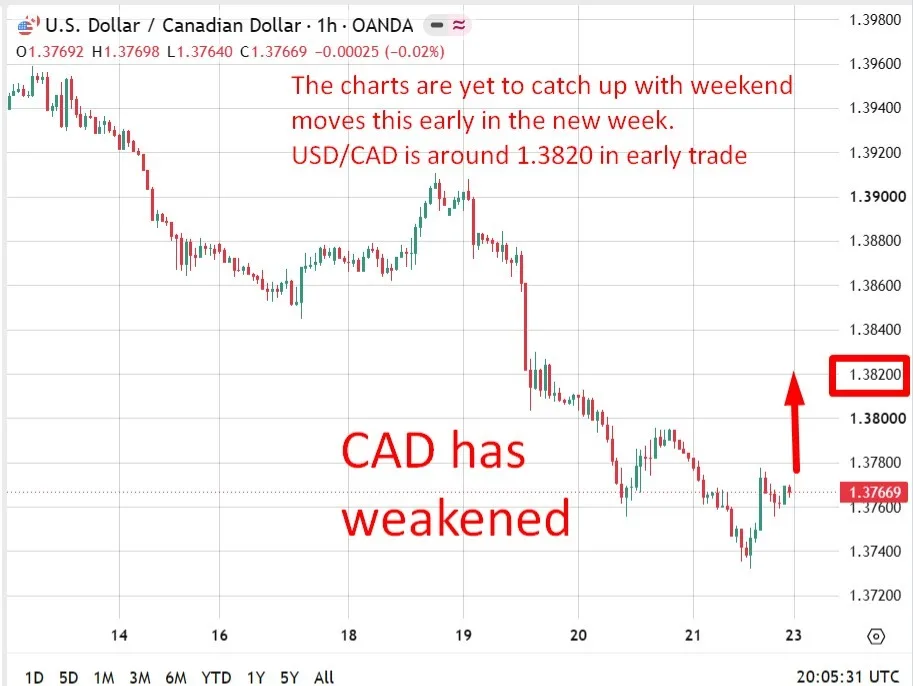
US Trade Representative Jamieson Greer pushed back, saying Canada walked away from a framework that included aerospace supply chain coordination, critical minerals cooperation and a structured path toward USMCA renegotiation. Notably, formal USMCA renewal talks have already begun with Mexico but have not started with Canada, a gap that traders may interpret as a sign of prolonged uncertainty rather than an imminent reset. The Canadian dollar came under fresh pressure following the news, with the currency's near-term trajectory now closely tied to how aggressively both governments escalate. Energy markets are also on watch, given the sector's historic sensitivity to any broadening of tariff scope.
Continue reading at Forexlive.